Plan Rendering Hand Drawing Techniques

If there is any word that describes what architectural renders look similar nowadays, it would exist: impressive. The immense world of rendering has allowed people to engage in virtually-congenital environments, exploring each space and experiencing what they might hear or feel every bit they walk past 1 room to another without being physically present in the project.
The main purpose of a render is to help viewers visualize what the final result of the project will await similar. Whether it is for presentation or construction purposes, architects need to translate their visions in a mode that helps people who were not involved in the ideation process understand the space and the experiences that come with it. However, not all architects have the proper skills or the time to create such hyper-realistic environments, but with the exceptional quality of visuals existence produced present and the rising demand, it has become somewhat mandatory for every project to be presented equally a realistic 3D render. So if you are one of those architects who don't have the skills nor time, here are means you can present your project as an immersive visual experience that translates its identity without resorting to 3D software.

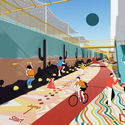


 + xi
+ xi
By definition, architectural rendering is the process of creating photorealistic images and 3D models using reckoner software. To create these virtual scenes, many elements are operated, such as lighting, viewpoint, reflection, surrounding environment, textures, and materials. And truth is, in that location are many ways to present these elements without real-time rendering and realistic shots. These substitutes can be divided into four categories: Hand Drawn, Hybrid, Digital, and Physical 3D Modelling.
Paw-Drawn
Monochromatic Sketches and Drawings

Sketches and drawings are some of the oldest forms of 2D visual fine art. In the field of architecture, free-hand drawings were used to convey perspectives, compositions, textures, patterns, and architectural ideas. Traditionally, these drawings were monochromatic, letting the shading and shadowing depict the depth of a space and create the illusion of lite, shadow, and perspective. And according to many architects, sketching is still considered as i of the most important advice and illustration tools that fills the gaps between the documentation process and product.
Medium: pencils, pens, charcoal, graphite, and/or markers on whatsoever flat surface.
Hand Sketches and Watercoloring
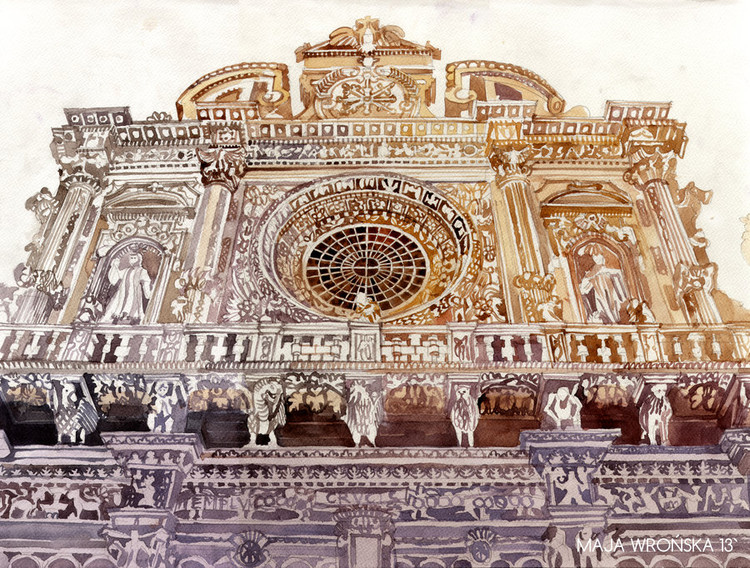
Towards the end of the 17h century in France, engineers and architects began utilizing color in their drawings, developing colored symbols that could exist understood past workers to designate materials and landscape. And as watercolors and new methods of painting were being developed in Belgium, sketches began to be published with a more artistic style, integrating landscape, backdrops, and people, leading to the get-go photograph-realistic renders. Because how aesthetically engaging these drawings were, architects began to sell their work as fine art pieces, and still practise to this mean solar day.
Medium: Pencils, pens, ink, watercolors, and/or pigment on any apartment surface.
Hybrid
Axonometric Perspective and Free-hand Coloring

Put only, an axonometric perspective is the process of transforming the cartoon from a second into a 3D past extruding the floor plan drawn on the CAD program. This orthographic projection is used to illustrate the geometric & structural appearance of a projection and understand it more than thoroughly. Often, this 3D file is then exported to the rendering software to begin with the visualization process. Notwithstanding, if this is where information technology gets difficult for yous, press out the axonometric perspective and coloring over the drawing, either on a transparent sheet or on the drawing itself, can help gear up the mood of the project and understand all of its characteristics.
Medium: Architecture drawing software, printed out axonometric perspective, transparent sheets, coloring pencils, markers, ink, watercolors, and/or paint.
Digital
2D / 3D Drawings and Photoshop (or whatever similar program)


Ane of the nigh popular visualizing styles used in the architecture and blueprint world over the last decade is digital drawing. It is a vast medium with numerous styles and techniques that sits betwixt the hyperrealism of real-time rendering and traditional hand drawing, and allows architects to experiment with collages, colors, textures, and textile overlay. In addition to working on computer programs, software like Morphilio facilitated cartoon details and rendering elevations, plans, and sections due to the option of drawing digitally by manus on tablets.
Medium: Architecture drawing software and photoshop (or whatever like program).
Physical 3D Model
Images from Concrete 3D models and Photoshop (or any similar program)

If you are familiar with adding materials on photoshop, using a physical 3D model is one of the nigh helpful and time-saving techniques. All you take to exercise is define the project's surrounding surround and how you want the light to flow through the infinite. Dispense the light and shadow using a warm-toned flashlight, and take as many pictures as necessary to get the perfect shots. After that, import these images on photoshop and add some materials and people to make the visuals expect as realistic as possible.
Medium: Physical 3D Model, flashlight, photographic camera, photography accessories, and Photoshop (or any similar programme).
This article is part of the ArchDaily Topic: Rendering, proudly presented past Enscape, the most intuitive real-time rendering and virtual reality plugin for Revit, SketchUp, Rhino, Archicad, and Vectorworks. Enscape plugs directly into your modeling software, giving yous an integrated visualization and design workflow.' Larn more near our monthly topics. As always, at ArchDaily we welcome the contributions of our readers; if you want to submit an article or project, contact the states.
Cite: Dima Stouhi. "Non Experienced with Rendering? 4 Techniques yous Tin can Use Instead" 07 Apr 2021. ArchDaily. Accessed . <https://world wide web.archdaily.com/959618/non-experienced-with-rendering-four-techniques-you-can-use-instead> ISSN 0719-8884
Source: https://www.archdaily.com/959618/not-experienced-with-rendering-4-techniques-you-can-use-instead
0 Response to "Plan Rendering Hand Drawing Techniques"
Post a Comment